Wednesday, December 7, 2011

Poverty and Community

Interview with laborers
Indira Gandhi Camp, New Delhi


[The interview took place in a small community of families living in closely-packed houses in the alleyways of a busy market area in Delhi. The tiny houses, which were not much taller than the people, were surprisingly equipped with electricity, and with several public taps. The roofs were covered with plastic sheets and pieces of metal, held down by rocks. The houses formed a wall of doorways and the lanes between them were quite narrow (5 to 8 feet wide) with a sewage drain running down one side. The two gentlemen we interviewed were seated in a string cot at the juncture of three lanes when we approached them. A small group of people gathered to listen to the following. After the interview, we were served chai and biscuits.]

[“S” begins.] I have lived here for about ten years now. My wife and I have five children. I used to work for an Australian company called SGP, but it closed down two years ago. Now I do odd jobs, such as painting and any type of occasional labor. The people who live here are of all kinds, but there aren’t any people who come and go. Mainly we see only residents. My father used to work in the American Embassy. He retired after 45 years of service. I was born in the city of Aligarh in Uttar Pradesh. These big boys standing here are my sons. We do all kinds of labor work to support our family. We do cleaning work, painting work, and any other work we can find. My wife and my daughters stay at home. I have a certificate from the company where I worked before, so I go and show this wherever work is available. If they like it, they hire me to do work for them. I hear about the work through others, just through word of mouth.

[“K”, a Nepali gentleman speaks.] There are about 330 families here with a total population of about 2,500.

[S] There is a man who claims to be a leader of our camp and he lives at the corner up the lane. But we don’t pay much attention to him. When we want to make group decisions concerning our camp, it usually happens spontaneously. We all get together to talk and decide. The actual leader of this camp is named Subhash Babu. He is an appointed leader.

[K] He was appointed by a government committee and he is our representative to present any problem or complaint to the government, such as problems with water or electricity. We are poor people, so if we go ourselves, no one is going to listen to us. But when Subhash goes, the government listens and we get some satisfaction. When big, big people give donations for the poor, Subhash has been able to get some of those things for us. So he has been a help to us. When missions donate things for the poor, Subhash has made sure that we are able to get some of that.

[S] He has helped us with our water and electricity problems.

[K] Religion, of course, is something that everybody here follows.

[S] Yes, whatever each person’s religion is, definitely he or she will follow that religion. It’s like this. If you feel like doing it, then you can go and offer some water, or light some incense in the temple. As far as organized religion here, there isn’t very much, though there are some people here who have some connection with more organized religious practices.

[K] But their leaders come from the outside. They don’t live here in our camp. Each person does a little, as and when he can. You see a temple down the lane over there. It was built some time ago. There used to be a pujari there, but he’s gone now. No religious leader is involved when people in our camp get together during religious festivals. For example, during Janmashthami, people got together and collected money to buy flowers and prasad to offer to the gods. There was no pressure to contribute. If one wanted to, that was fine, and if not, that was fine too.

[S] I am a Hindu. That’s my religious background. The whole world follows bhagvan. Some follow Allah, others follow a different bhagvan. There are many different gods, like Shri Krishna, Shri Ram and many others. I follow them all. There’s no special bhagvan for me.

[K] They all follow something. Some follow Shiva, some follow Krishna, and some follow a devi. They all follow some deity. There is a tradition here. Whichever tradition exists, that’s what we follow, whether it has many gods or not. We follow the whole tradition.

[S, concerning poverty.] This country is of course my country. I have to live here and follow the ways of this land. This is part of my life. Poverty is nothing special; it’s everywhere. Every country has poverty.

[K] The poor man dreams and longs to be a prosperous merchant-type person. We all want to be like that, but it never happens, so what can we do? [A few in the crowd responded to this comment with friendly chuckles.] I receive joy when there is good provision in terms of eating, drinking and living. Otherwise, there is sorrow and suffering, both in my body and in my heart. The effect of poverty on a person is that he has to cry. He really has to cry. What else can one do? Even in poverty, when you follow religion, you should do pious things that will bring you rewards. Do you really think that by doing sins we will get help in our poverty? Our whole camp knows that I have been close to death a couple of times in my life. During those times I prayed to some devi and I was able to escape from death. Three children have even been born to my wife and I. The sickness was there in my bones. I was sick for 32 months. I had to take medicines for that long. I prayed to the gods of my ancestral household. It wasn’t puja, it was prayer.

[When asked if they have ambitions of escaping poverty, one man in the crowd replied:] When we don’t get work, and the needs of our children and our families are not met, then how can we make plans? Just living from day to day is what concerns us. We just hope that we’ll be able to get a good job and move forward in that way. We just live and try to provide for our families, and then we die. What else is there?

[K] If your life is full of good luck and provision is made for your needs, then your life’s goal is achieved. There is no other goal for life than that.

[S] Every human being thinks simply this, that “my children and my family should live decently and have their needs met.” There are all kinds of problems we face. And no one is there to solve these problems for us. We have to solve our own problems, as long as we have life in these bodies of ours. We have to depend on ourselves. For example, I may have a problem where I would like to construct a building or make something, or do some other kind of work. And it doesn’t happen. So, there are all kinds of problems in life. Or the problem might be that we have to raise our children, we have to work, we need to build a house for ourselves. So these are the sorts of problems that come up in our daily living. As far as basic facilities, we have no problems. There is electricity and water, and government hospitals have been built for poor people. We don’t have to spend a lot of money when we are sick. The hospital will tell us what medicine to get and we will get it. So, in that way, there aren’t any major problems.

Astrology and Vaishnavism

Interview with a Vaishnavite priest
New Delhi


I have earned the Shastri title from Rashan University. After [my predecessor’s] death, I took over the work of pujari. The Shastri title is earned through studying astrology, Sanskrit literature and grammar, and karma kand. My older brother is the head pujari here, and I am his assistant. My brother and I are here to perform religious duties. We have various assistants who help us by keeping things clean and working as security guards, and other practical duties. My brother and I are the only specialists in performing religious ceremonies and astrology.

In our Hindu religion, people accept one of two basic viewpoints — the Vaishnavite or the Smarta. Among the latter are tapasvis, who may also be called sanyasis or sadhus. While keeping their senses under control, they live a life of begging and ascetic practices, renouncing the world, and they work toward achieving spiritual progress and power. Vaishnavite people are those who perform the worship of bhagvan. We do this by building on a particular foundation in relation to a particular isht-dev or kul-dev. In terms of our works of discipleship, our isht-dev can be Ram, Krishna, Shiva, or various devis. So we perform the worship of all of these deities.

In addition to these, we have the sun, the moon and the heavenly bodies. From these we are able to receive knowledge, and because of their unity in giving us this knowledge, we consider them as deities and we worship them. Even in our shastras it is written that these heavenly bodies are gods and should be worshipped as such, because they give us light. Just as a person has movements, development and progress, so do these heavenly bodies. That’s why we consider them to be gods. Because within them, there are mariyadas. Those which have become purushottams have become our bhagvans. It is by following the mariyadas of these bhagvans that we have ended up worshipping them. So in the same way, we worship the heavenly bodies. They have the attributes of being protectors as well as descendants of the deities. Therefore, we worship them.

Our astrologers have taken the akhants of the sun and the moon and have used them to make the panchank. In this work, ank-ganit is used. The major basis of calculation in our astrology is the number system, zero to nine, by which time periods are calculated. By the mathematical methods known to them, our astrologers fix the dates of the panchank. The days on which we have to do gyat are determined by these methods. Each date is looked at in terms of how it relates to the stages of the moon and what sorts of advantages and disadvantages it has. Then on the basis of mathematical rules, we convert the days into hours and minutes. We divide every hour into 60 minutes, and every minute into 60 seconds. So this is the main point about our astrological system.

The next thing we do is we look at what star or planet appears on each particular day. This is ascertained by means of our panchank. There are 30 days in our month, and we divide this into two 15-day periods. The first of these is called krishna-paksh. The second period is called shukra-paksh. In the light half, we count the days from one to 15. In the dark half, in the same way, we count from one to the night of the full moon. So, we look at these dates in terms of stars and planets, and we will find only one verification of this in our astrological holy books. It isn’t changed in any place or in any way, but is definitely fixed. There isn’t a need to appeal to any rule about this. These things have been fixed in all ages — in the Sat Yug, in the present and also in the future.

After we find out what the star or planet is, then we want to know about the carn and yog of heavenly bodies. Then we take this juncture and this date and determine what has been ordained to happen on it. From this we have the rules of astrology by which we tell people what they need to know. If we make sure that we avoid those days which are inauspicious, then we are free to work to do anything we need to do on the other days. If we have to get something done, especially something important, on a particular day, then we go through the process of asking what the date is, and what the stage of the moon is (for you see, the moon changes every day).

When a person comes to us, we use his name and on the basis of that, we begin our calculations. Our astrologers have said that we should avoid the second, sixth, eighth and twelfth days of the lunar month. The other days are auspicious for us. So this is how we fix our auspicious times.

We are able to cast the horoscope of any particular time, place or person, by means of a panchank. This particular panchank [he brought one before the interviewers] was issued by one of our pandits in Jaipur, Rajasthan. From this we get our foundation for constructing a horoscope, and every year a new panchank is issued. In each issue, there is a detailed description and explanation of the whole year. If we look at each table in here, it is for a single month. There are twelve months in our calendar. Each month’s table has rows for every day of the month. The date is given in each row, and the first column shows the day of the week. After that we have every hour, every minute of every hour, and every second of every minute. Then we have the planet or star given and the precise time of its appearance, down to the minute and the second. After that is given the conjunction of planets and constellations. Again, the precise time of appearance is given. Last of all, the incline is given along with its time of appearance. Then the Western and Muslim dates are given for each day. Panchanks are issued from many different centers in India, but they are all the same, because the root of them all is mathematical calculation. And the root of the calculations themselves is found in the sun and the moon.

Let me give you an example. If we take a circle of paper, place it in the sun, and place an upright stick in the center of it, then the shadow of that stick will fall on the paper and will move in accordance with the way in which the sun keeps changing its pattern of movement. And the watches we have, which have been constructed in accordance with scientific principles, can be matched up with these movements of the sun. So our astrologers have studied these solar movements and have captured the mathematical description of them. So that is why the basis of our mathematical calculation really is the sun, and along with that, the moon.

When people come to us, they ask questions about their family problems or appointment difficulties, or other such problems of life, requesting guidance and help from us. We, in turn, do not ask any information from them other than their name. From the name, we determine the sign of the zodiac and we use that to make some astrological calculations. We look at the phase of the moon and we look at our sacred astrological books, as well as charts given to us by various gurus and sants. The verifications given to us by these spiritual leaders or books help us to give clear directions to the seeker. We can give them information about the past, the present and the future. Due to the blessing of bhagvan, truth comes out from our lips and we are able to give the seeker the right procedure to follow in solving his problems. For example, we could tell a seeker who has committed a particular sin what sort of procedure he could follow to gain merit and thus be freed from the penalty of that sin. If someone is going somewhere to get something done, we can show him the best procedure to follow, or the best time to follow, so that his work will be successful. Any and all sanctifying or purifying rites from birth to death, are covered by this system of astrology. All circumstances of life are covered. If one is seeking prosperity and progress in life, such as in a business, for example, or if someone is getting married or buying a vehicle, then we show him the best time to get these things done.

Astrology has various inputs into it, such as mathematical calculations and verses from the holy books. Along with this, it is important to worship some deity in order to gain siddhi from that deity. For that deity, we are supposed to do something very difficult, something that involves a lot of labor. Family worship and the singing of bhajans are also required. The effect of all this will be that we begin to build an attachment to that particular deity. We receive siddhi from that deity, and somehow we are able to receive words of truth as a result of that. We proclaim those words to the seeker. We receive powers to do special things, such as to bring healing to people who are physically sick, and we are able to solve many kinds of problems in life. But to receive such powers, one has to make all kinds of sacrifices. Not everyone can do this. So the special powers that we have are related to the system of astrology and astrological writings. There is no question of some spiritual beings coming or not coming. That has nothing to do with this system.

When we look at natural things such as being born and living a short or long life, this is ultimately not a matter of science. When we look at plants and trees, and we say that we have a seed, we are going to sow that seed, fertilize it and water it, and then we will have a plant or tree. This is not just a matter of science, because where did these things first begin? Where did trees come from? Where did man come from? When we begin to think about these things, then we come to infer that there is some power behind all of it, and it is through that power that all these things are happening. There is definitely a creator behind everything, and that creator is dev. Those devtas who were there during Sat Yug are also here in the present time, in Kal Yug. The brahmins of former times are the brahmins of today. The kshatriyas of former times are the kshatriyas of today. The vaisyas of former times are the vaisyas of today. And the shudras of former times are the shudras of today. It is through their works that they have all become what they are. And through their works we have been able to discern in the Vedas certain mantras by means of which we can produce fire. We are able to do that today, even as we have done it in former times. In the olden days, there used to be wars in which people would shoot arrows from bows. In the same way today, we have mantras, religious rituals and worship rituals, by means of which we can finish off an enemy, even if he is about two hundred miles away from us. But in order to gain these powers, we have to do rituals and we have to work hard. So when we look at the creation, we realize that there must be somebody behind it all and that’s why, when we do the worship of some particular dev, our requests are granted. Then why won’t we follow that dev and consider that dev to be our own? That’s why these statements are all true.

[Concerning the Vaishnavite branch of Hinduism] The Hindu religion is one. But we have divisions within it. Just like Buddhism and Jainism developed in many directions, so it is with Hinduism. But these divisions didn’t come by some act of splitting us up into many factions. There are four life stages in the life of a pious Hindu, and our holy men have followed this since ancient times. We Vaishnavites believe in all four of these life stages and we practice them. From the ages of one to 25, we have what is called the bal ashram. From 25 to 50 years of age, we have the grihast ashram. From 50 to 75, we have the vanprast ashram. And the final life stage is the sanyas ashram, which is from the ages of 75 to 100.

We get married around the age of 23 to 25. Prior to that is the age of playing and eating, enjoying life and gaining knowledge. And our astrologers have said from the very beginning that a man becomes mature at the age of 25. Only after getting married will he be considered a householder and a grown-up citizen of the community. When his householder stage has been completed and he reaches the age of 50, he will be considered as a great person in the community, worthy of respect. His role in the community will be to care, not only for his family, but for the whole community, and to be a person who gives guidance and advice concerning how to live a virtuous and wise life. And beyond that age, his duty is to leave the illusions of family and worldly life and commit himself to a life of bhakti to bhagvan. For his own good, he would need to follow certain practices in order to gain moksha from bhagvan. Those who follow these four life stages include not only Hindus, but Muslims and even Christians.

The unique thing about Vaishnavites is that we also consider fire, the sun, and the meek acceptance of life as having special significance during the sanyas stage. Doing tapasya while sitting in the sun is an example of this. That’s why we become smarta. They have become holy in themselves and are considered pure even if they do not bathe. Now there’s a basis for becoming a Vaishnavite. That basis is the foundational principle of worshipping Vishnu. This means that we worship only those deities which are considered to be avatars of Vishnu. Actually, all the devtas are avatars of Vishnu. This means that all of us Vaishnavites have chosen an isht-dev for ourselves, and that isht dev is an incarnation of Vishnu. That’s how we have gotten our name as Vaishnavites. Some follow Ram, some Krishna, some Hanuman, some Durga, and so on.

In every religion, the biggest thing is shraddha. Whether we are talking about shraddha in a person, or in a dev, or in a vraksh-dev — whatever it may be. The point is that shraddha is something very special and necessary. We find it written in the Vedas also, and we see that even concerning shraddha toward our parents, that is also enjoined in the holy books. So, shraddha is the biggest thing. When Ram won the victory over Ravan in the great war, and when he went through great sufferings, and in the end became Mariyada Purushottam Ram, then we realize that shraddha is the most important thing.

If I were to give you a definition of the reliability of Hinduism as given to us by the leaders of our Hindu society, then the first thing we see is that there are certain very special places around the country. For example, in Jaipur, there is the mandir of Shri Govind Ji. If any person goes to this mandir 100 times, then any difficult request he may have will be granted. I can tell you about the situation in Delhi. There is a mandir of Hanuman in Jamuna Bazaar. I can tell you that if any person goes to that mandir 40 times, then he can receive anything that he desires.

There is a small village in Rajasthan called Lilka. There is a very great temple in that village, and the sants of that village are very great. This is a true story. There is a tantrik who is still alive today and from whom we can get direct knowledge about this. The story is about one of the sailors in our navy who went abroad to fight a war. In the war, his ship began to sink. So, he began to chant the name of a particular guru. He began to say “Jay to Mangaldas Ji Maharaj.” By the power of that name, the boat stopped sinking and rose back up to the surface of the water. The people of that area witnessed to the truth of this story. It is true. I myself can give you a testimony about this when I went to that area eight years ago, along with my guru ji. One of the great gurus of that area had just died. And as you know, the custom is that 13 or 14 days after such a man passes away, many sants and gurus gather together and a large meeting is held. At that time, food was being prepared for those who had gathered, and there was a shortage of food. They had quite a shortage of oil to do the cooking and frying, so some of the sadhus and mahatmas gave orders that water should be taken from a small cement reservoir nearby. They said that the water should be poured into the large vessel that was used for deep-frying food, and that in this way, the food should be fried. So, that water actually worked just like oil, and the cooking was completed. There are reports about Badrinat. There are several bathing places there, at which if a sick person takes a bath, he will be healed. And so, in these ways, there are natural phenomena which have been reported. They constitute a kind of tangible sign of the fact that there is actual power behind our religious system.

In terms of my personal experience, I am a follower of Hanuman. He is my isht-dev. I have also received instruction from my guru, Pandit Shri Shankar Das Shastri, and my father is Pandit Shri Harilal, who was a teacher of the holy books. I have received training from both of these men. I am a brahmin and I am a performer of religious rites in the prescribed manner. I began this training at eight years of age, receiving sanskar at that age. Then I took great interest in learning the ancient Sanskrit literature. I studied about performing rituals properly and I also studied astrology. I perform religious rites daily, and follow the instructions given to me by my guru. And my isht-dev fulfills all my desires, even as I perform puja to him. Once my younger brother needed an operation and I was in great distress about it, looking for a place to get it done. I went all the way to Puna and back to Delhi, but nothing was working out. So I put my request before Hanuman and he gave me darshan of himself. He appeared to me in a dream and told me to get the operation done in Rajasthan. So, I took my brother there and got him admitted. The doctors had said to me that it would take ten to 15 days before the operation could be done, but actually without us doing anything, they changed their minds and the operation was done immediately. It was very successful and even today, my brother’s health is fine.

Predictions that I have made concerning things in the lives of various seekers have come true. I have never given predictions or guidance in a flippant manner to cause harm to anybody. When we astrologers make predictions and give guidance, we have to do it according to the circumstances of the seeker, even if our predictions are based on mathematical calculation. Calculation is not enough, we also have to discern the circumstances of the seeker and adjust our predictions accordingly. We look at the circumstances, at the environmental factors and the condition of the person, and this helps us make more accurate predictions.

The Significance of the Ganga

Interview with a Brahmin river guide
at the sangam, Allahabad


This fort [ancient fort by the sangam] was built by Akbar, one of the Mughal emperors. It was built here because of the beautiful view. During Akbar’s time, he had an army here, and also servants. It is now in the hands of the Indian army. There’s an ancient banyan tree growing over the wall of the fort, and we can see roots coming down over the outside of the wall. This tree is as old as the fort.

The river is holy because it came here through the thapasya of the rishis. Thapasya is when people put forth effort. For example, Muslims remember the name of Allah, remembering him for one year, ten years, or whatever. [You do this] until you get peace in your mind, once you get the darshan. This present age is the Kali Yug. The thapasya [which brought the river to Allahabad] took place in another age, the Satya Yug. The name of the rishi was Bhagirathi.

Anyone who bathes in the river, and has a sickness, will be cured. Where the river originates in the mountains there are medicinal roots and herbs which give the river healing properties. The water is good for skin diseases too. This is why our people do puja to the river. If you get up before sunrise, bathe in this river and drink its water, your mind will be cleansed and your body will be healed of all disease. I have not personally experienced healing from the river because I have not had any sickness, but I have seen with my own eyes, those who have been healed by this river. It is not just hearsay. If you take the water of any ordinary river and store it in a container, within a week or a month, it will go bad. There will be organisms in it. You keep this water for 100 years, or 50 years, and it will not go bad or have a bad smell.

[A question asked by the interviewers, who had witnessed on two occasions the partially-burned remains of dead bodies in the river: “Why are dead bodies thrown in the river?”] Dead bodies are not put in here. You don’t see any, do you? They don’t put dead bodies in the river. They bring only the bones, and they have a puja done. One of the pujas done at the river is for departed loved ones, parents in particular. This puja is called pind dan, offered to spirits of ancestors by their nearest surviving relatives. This pind dan is done for people who have died sometime back, but can also be done for people who have just died, and whose bones are now being brought to the river. They will do it for the father, then for the grandfather, several generations. In that way, they feel they are covering their whole family. This puja gives peace to the soul of the departed relative.

Another puja that happens here is the worship of the river itself. For the puja of the river, the Ganga puja, the offering is a mixture of milk, flour and coconut. This mixture of three items corresponds to the three rivers which meet at this point — two real, and one mystical, the Sarasvati. Two rivers come from the Himalayas. The Ganga comes from Haridwar via Kanpur. The Yamuna comes from Delhi, Agra, and Mathura. The Sarasvati runs underground, it comes from here only. It starts here and ends here.

The worship ceremony has to be done by a Brahmin priest who is given a donation for his services. It involves chanting some words from the Vedas before putting the offering into the river. The ritual has to be performed by a Brahmin priest, because others don’t have knowledge and experience of the Vedas. Sadhus do not do pujas. Sadhus are simply people who ask for things — “give me gold, give me silver.”

[We asked the Brahmin to tell us about the Kumbh Mela, and he said, “I’ll be glad to do it, for a donation.”] Allahabad is one of the four sites of the Kumbh Mela, the greatest bathing festival of the Hindu religion. The story behind this festival is that one day, the devtas and the rakshas were churning the sea. This produced 14 different types of nectars. The best out of all these was the nectar called amrith, because drinking it would confer immortality. The devtas and rakshas began to fight with one another over the amrith, of which only one vessel-full was available. Finally, they reached a compromise.

The god Vishnu came and said, “Why are you fighting over this? We have worked together to get this amrith out of the sea. Both devtas and rakshas have equal authority over it. Vishnu made the rakshas and the devtas sit in separate rows, saying that he was going to divide the amrith among them equally. He gave amrith to the devtas and he gave an intoxicating drink to the rakshas. Two rakshas, Rahu and Ketu, didn’t drink it. Vishnu took the amrith and began to run away, with Rahu and Ketu chasing him in order to get some of the nectar. While he was running, some of the nectar spilled at Haridwar in Uttar Pradesh, some at Nasik in Maharashtra, and some at Ujjain in Madhya Pradesh. The remaining nectar, Vishnu brought to Prayag and dumped it here. At these four places, the Kumbh Mela takes place. The Kumbh Mela takes place only once every 12 years, with the four sites taking turns at hosting it. The last one was held in 1989 in Allahabad. The next one will be held in Ujjain in the year 2001.

There are 2,000 Brahmin priest families that live by the river here in Allahabad.

[At the sangam itself we can see the swiftly flowing Yamuna joining the more sluggish Ganga. During the rainy season, the waters of both rivers look somewhat muddy, but in other seasons, the rivers are of different colors — the Yamuna green and the Ganga a pale, whitish hue. In the middle of the Ganga side of the sangam stands a large statue of Shiva coming out of the water.]

Items Used in Ritual and Worship

Interview with shopkeepers
near the sangam, Allahabad


I live here at the sangam. I belong to the Nishad caste. We are boat people. We are also called kevats.

We use chandan to mark our foreheads and also in temples. It comes from the sandalwood tree. Pilgrims as well as holy men have their foreheads marked with it. The chandan comes in the form of a lump. You take the rodi and make a mark. If a person is poor and he doesn’t have this, he will mark his forehead with kevad. But if God has given him more, then this is a rodi of chandan, and he will use this to mark his forehead.

This colored powder [red or orange] is for putting a mark in the part of a woman’s hair to indicate that she is married. It is used only by Hindu women. The difference between red and orange is a matter of taste or style. The orange is also considered as the special color of Hanuman. The orange is used in temples, but the red is not. The red is used only for the marking of married women’s hair. But the orange is used also for that, as well as for pujas.

The colorfulness represents joy or celebration, whereas only a widow would wear white, the color of mourning.

There are 16 signs of the married woman in Hinduism. One is the mark on the forehead. Among the other 15 signs are a toe ring, anklet, bangles, a sari, blouse, a piece of jewelry in the nose, ear rings, and a necklace. If a girl is unmarried, she will not have a toe ring, a mark on her forehead, or a mark in her hair. But she can wear the bangles.

This is a form of prasad [shopkeepers point to white sugar balls sold in plastic bags]. These are offerings made to the gods, used by pilgrims. This is bought by people from all over the country who come here. It is considered very holy prasad, because it belongs to the sangam here, to prayagraj. A small amount of the prasad is placed before the idol, and the remainder is distributed among worshippers to be eaten.

These [strings of orange and yellow cotton strands, similar to a mop-head] are tied to the wrist or around the neck of devotees as they sit and listen to the telling of the myth of a deity named Shri Satyanarayan. While the story is being told, which takes a whole day to tell, the listeners have to fast.

[The story, in brief, as told by Sanjay, a high school student:] The story of Satyanarayan is historical. The basic idea in the story is that someone went to another person and made a special request for his life, and that person made the request come true. The one who made the request worships the grantor of the request. Satyanarayan is a devta. There is no idol of this god. He is God, up in the sky. I cannot tell you the story, only a pandit can. [“But we want to hear your idea.”] Oh no, we all have the same idea. We think exactly alike. We understand the story, but we are not able to tell it. If I tell you the story, I’ll become a pandit and I’m not supposed to do that. Out of respect for my religion, I will not do something that I’m not supposed to do — even though it wouldn’t be a sin.

In the Hindu religion, the devtas have made four caste groupings: the Brahmin, the Kshatriyas, the Vaisyas, and the Shudras.

[The shopkeepers point out shiny gold threads with pink cotton balls on either end.] They are worn on the wrist or the neck of a devotee. The benefit one gets from it is raksha. In terms of wearing a thread on your wrist or neck, it is considered more auspicious to wear the kalai dhaga. They are more favored by the religious leaders than the chamki dhaga.

Truth, the Mind, and the Vedas

Interview with a priest
Adi Shankar Viman Temple, Allahabad


I have been working here for eight years. I perform pujas in the temple. This is the Adi Shankar Viman temple [literally, the “aerial vehicle of the primeval Shiva”] . It was built by a Swami Ji of the Mukudi pitham in Kanchipuram in Tamil Nadu. His name is Shankaracharya Ji. He has built several temples. There is a small one in Dharaganj. That is called the Siddheshvar temple. In Allahabad we have the big Hanuman temple. Then in Civil Lines (a business district in Allahabad) there is another Hanuman temple. In Dharaganj there is another temple called Venimadhav. And there is a Ram-Janaki temple here, built by the Shankaracharya of Badri. It took 15 years to build this temple here. These temples are all intended to give everyone a chance to have darshan of bhagvan. After bathing in the Ganges, one has to get a darshan of bhagvan, that’s why these temples have been constructed.

I used to live in the state of Karnataka. After that, I came to Kanchipuram. I studied in the math of Shankaracharya Ji. After finishing my studies, I went to Vijaywada. There I was a teacher of the Rig Veda, the most ancient of the Hindu scriptures. After that, Shankaracharya Ji sent me here. I am a teacher of the Rig Veda. In the Rig Veda I have studied, first of all, samhita. After that I studied padam. After that, there is what is called prayog. Within that, there is garvati homam and sabhavan, types of sacrifice, and I know all of that. I know all about havans. And I was teaching about these Vedic rituals in Vijaywada.

[Concerning rituals] There are four Vedas, which are writings about bhagvan. These four are the Rig Veda, the Yajur Veda, the Sam Veda and the Atharva Veda. And I am a specialist in the Rig Veda. In that Veda, the bhagvans are all one bhagvan. Their names are all different. One has to perform all the havans. Havan means yagyam. Different gods are given ahuti of ghee. This is all what we mean by havan. When we put ghee in the fire and offer it to the various bhagvans, whichever bhagvan it’s offered to, along with saying svaha, it reaches that bhagvan. As for arti, when it is done for a particular bhagvan — all bhagvans are manifested in the svarup of fire. This is why, in India, when we write the names of bhagvans, we write the word shri. The sacrifice reaches the bhagvan when we use his name, just as when we mail a letter with somebody’s name, it reaches that person. In performing a havan, one has to cut a piece from a tree, which we call samidh, and put it in each fire. These days, they say that the atmosphere is very dirty, and putting the samidh in a havan helps to clean the atmosphere. This is why in early times, we didn’t have all these sicknesses, such as we have these days — cancer, etc. In the early days, havans were performed more frequently.

In the Vedas there are mantras, different ones for different bhagvans. And we say those as we perform the havan. When you see blue light in the flame, then you know that the bhagvan has received the sacrifice. There is never a time when we don’t see a blue flame — the blue flame occurs always. The blue flame only comes when the bhagvan is satisfied with the offering.

As far as the role of the intellect in Hinduism, it is wed for the practice of yog. The intellect is important for reading and learning about the Vedas. For example, Jagatguru Adi Shankaracharya had a very good intellect and that’s why he was able to teach so many people. He had a great mind for the Vedas, so he has a very high place in our system. We feel that if his knowledge was a hundred times, then ours is only ten times. There is a Sanskrit verse which goes like this, [“The whole world is in bhagvan’s hand”]. That’s the way it is. And those who know all the mantras of bhagvan, they are the ones who are favored and forgiven by bhagvan. The Brahmins who know the mantras are like our devtas.

In my personal life, it’s like this. I have houses, fields and property. I have everything. My brother is a lecturer in a government junior college. I am not married. I intend to get married after two or three years, but I am thinking that I need to live according to the Vedas which I have studied. If I don’t do that, I’ll have to work in some other type of place. Now here, they have no teacher of the Vedas, so they are calling me here. I am also getting letters from the Maharishi Mahesh Yogi Center in New Delhi. They also want me. But this is Shankaracharya Ji’s math, and that is where I have studied. This is why, in accordance with the orders given by Jayandra Sarasvati Swami Ji Maharaj, I have come here.

In my home, we are two or three brothers. We also have a sister. Everyone’s marriage has occurred, except for mine. My younger brother is still at home. There are no difficulties at home. As long as we keep serving bhagvan, then he won’t take his hand off of us. It is in this life of trust that we exist. Everything that I have asked of bhagvan, he has given me, up til now. I wanted to do something with the Vedas, this is what I asked of Makshi Devi. I have now arrived at that position, working with the Vedas. Then I said that I wanted a good job, and that request also has been granted.

The bhagvans don’t ask anything of us. The only thing is that the bhagvans want us to perform the pujas. That’s why I left my position as a teacher of the Vedas to come here and do this work. Bhagvan is all one. Even in the heart of man, Brahma is there. That’s why, when we do any work, we put our hand over our heart, because it is not us who are doing the work, but rather it is bhagvan who has caused it to happen through us. This is why bhagvan is in us. Bhagvan is also in the form of man, as well as within man. Whatever we do, we say we did it, but only with our hand over our heart.

The bhagvans have heard my prayers, but still sometimes I do experience doubts. I’ve been working here in the temple for eight years. Some time during that period, I took a year’s leave from here. After that year was over, I still didn’t want to come back, so I didn’t. But then bhagvan came to me in a dream and said, “Why have you left me and gone? Do you have any intention of coming back or not? If you come back, you will have good fortune.” So that’s why I returned. Actually, I don’t only have to do pujas and worship. I can also be a teacher. In fact, I could even be a farmer and my farming could be blessed and approved by doing pujas. So I don’t have to only be a priest. If I didn’t worship bhagvan, it wouldn’t be good for my mind or my heart. In the end, I would not be favored by bhagvan. So up to now, I haven’t stopped doing worship. Even when I’m at home I keep it up. Just like all rivers flow into the seas, so all gods are one. That’s why everyone goes to some particular bhagvan. So one can worship Shiva, Vishnu or a devi.

The point about worshipping, even though we ourselves are bhagvan, is that not all of bhagvan is in each of us. One out of a hundred powers of bhagvan may be in each of us. Ninety-nine percent of Brahman is separate from us. Ninety-nine percent of bhagvan is outside of us. One of his powers may be on you, and one may be on a cow. Bhagvan is in each and every one in some small measure. That’s why in everything, such as cows, etc., bhagvan is there.

The world is illusion because we desire something, we get it, then we have a further desire, and so on. So it’s all illusion. These desires come from many different directions. Someone might want a piece of land, and after he gets it, then he wants money. This illusion is connected to always hoping for things. It is not wrong to hope for things, but one shouldn’t hope too much. Hope is important because by hoping we are able to come up in life.

Man’s births are few. There are many rebirths, hundreds of thousands. In the form of an insect or a dog, and so on, there are many such rebirths, but being reborn as a human being is much less frequent. That’s why when one is reborn as a human being it is very necessary to spend one’s time remembering bhagvan, because there are many births in which one comes back as a cow or a dog, and so on. One can even have a small birth, as a frog. The difference between us and these animals is that we have an intellect, a mind, and they have much less of a mind. They do not have the capacity to be concerned about bhagvan, whereas we do. They do not have a capacity for laughter, but only for crying. In the Vedas also it is written that we should practice yog. This is very good for the body.

Even though things are illusion, the bhagvans are not illusion. The idols we make of them are not illusion. For example, there is surya bhagvan, the sun god. Now if there wasn’t such a bhagvan, what would happen? The world would be dark. That’s why for those who do religious rituals, it is written in the Vedas that bhagvan is up above. Surya bhagvan is reality, not illusion. Some people think that if they commit sins, there is no one to see. But Agni is there, vayu bhagvan is there, surya bhagvan is there, the earth is there. They are all there watching us. They all go and tell about us over there, to Chitragupta.

There is a great difference between truth and falsehood. Those who conduct their lives according to truth live very good lives. As far as those who base their lives on falsehood, you can observe for yourself how they are suffering in many ways, such as contracting leprosy, and so on. Those who live in small, little huts, such people previously used to live according to falsehood. Those who have a trouble-free life now are reaping the reward of living according to truth in previous lives, and those who suffer are reaping the fruit of falsehood. How do we know if someone has the truth? Such people will believe that one shouldn’t tell ties. One has to tell lies sometimes, but not too much. Also, one shouldn’t shed the blood of others. And also, one shouldn’t steal other people’s money. Those who do not hurt others, this shows that they are people who have truth. Those who are doing immoral deeds in this life itself, at the age of 60 or 70, they are very repentant. Some of them don’t have children. If we function according to truth, we will see that our prayers are answered. As for those who do evil and still prosper, they think that there is no afterlife, that this life is all there is. That’s why they do a lot of evil. But later on they come to realize. They come to realize their error because of the fact that, for example, children are not born to them, or their son dies when he’s still only seven years old. Seeing all these troubles come to them, they begin to see their error and regret what they have done. Money isn’t the only way in life, even those who have money sometimes are childless.

Thoughts on the Hindu Religion

Interview with a devotee
Hanuman Temple, Allahabad
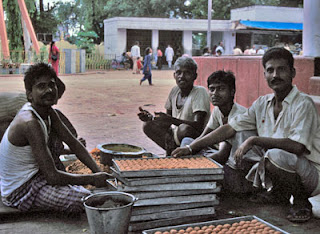

I am a mechanical engineer by profession. I have a BA in mechanical engineering and a master’s in production. I plan to do my doctorate very shortly — maybe in the States, maybe in India. It depends on my family and my circumstance. I’m a lecturer by profession. That means I’m a teacher. I have teaching experience of ten years. I’m a graduate of University of Allahabad. I was a gold medalist in my master’s. I got married in 1988. I have a son who is going to be two years of age soon. I am vegetarian.

Previously I used to eat meat, drink and smoke. I have taken drugs also. I used to smoke ganja. And I was a thief. I used to steal out of my father’s pocket. Daily I used to steal ten rupees. He never used to know. Once I was crying and he said, “Why are you weeping?” And I told him the real story that, “Father for the last three years I have been stealing five to ten rupees a day.” I was just ten years of age. He said, “Why are you telling me?” I said, “Today I have come to know that stealing is bad.” And he was also weeping and said, “It is good that you confessed.”

I was also smoking at that time. Once my mother caught me. She slapped me and said, “If you are going to smoke again, I’ll tell your father and he will shout. A lot of people will hear that you are smoking.” I felt afraid, I felt guilty. Then my motivation changed. It is nothing religion has to do. It is only with self-motivation this comes. Now, for the last 10 to 15 years I have left everything and I have dedicated myself to some supreme power, and I respect the good things of every religion.

My hobbies are helping the poor, giving food to poor animals. Whenever I give, I am thinking it is not me giving, but God is giving it through me. He is directing me. I normally teach my students in the course of lecture all these things. If they are able to save one rupee a day, they should give it to some poor person, irrespective of what caste he is. Feed some poor people. If you are feeding hungry people, you will have a satisfaction in your heart. So these hobbies have come. Whenever I invest money I think I should invest it in good work. I am a very social man. I like to be friends with everybody. I have friends in all castes.

This is one of the very famous temples of Allahabad. It is the most spacious also. Basically, this temple is dedicated to our Lord Hanuman. People think he is supposed to be the servant of our Lord Ram. So indirectly we are worshipping Lord Ram. Where we are sitting, just to our back is Lord Shiva’s temple. People in the city have a lot of faith.

Most of the people who come here are vegetarian. They don’t prefer to take eggs. There is no hot and fast food. But people think that they want to be vegetarian. I used to be non-vegetarian. But after coming into contact with these temples, in the last ten years, I have left everything. I even don’t wear leather. People interpret it many ways. In India, normally people think we are killing. We are killing plants also. Plants also have life. Most of the majority of Indians are illiterate people. So once when they feel something, they think it has got a life. But if I go a village and explain to them that plants also have life, they will not believe me. They’ll say, “No, they’re not alive because we are not able to feel their pain.” But there was an Indian scientist who has proved that plants have life. So basically people are not able to convince this illiterate man because more than 60 percent of the people are illiterate in India. They won’t understand the basic culture. They won’t understand Hindi also, properly. Now, because of the vast difference in language, you’re not able to communicate your ideas well.

Now, these animal products we are discarding are the reason that they are able to see their pain. This is another factor, they are able to see the pain in the butchering of animals. On the other hand, most of the gods have their own sort-of raid. So for example, we are seeing this. We see horses there, lions there. Suppose they are just wearing the shoes made out of horses skin, they’ll think that they are just killing the servant of that god. And that is the reason they are avoiding leather and not eating animal products. In the ancient times we used to worship animals also.

In India it is the culture in order to show respect, we touch the feet and put them on our forehead. That means that your feet are so auspicious for me that I’m keeping it on my head. That is supposed to be the first thing. That is why we are touching the feet of the deities here, and touching the temples. And we offer sweets also here. We think that once we bring sweets to the temple as if God has taken some out of it, and the remnants of the food we are taking, that means God is pleased with us and we are having sweets. We can’t offer salty things, because we think salt is not supposed to be very auspicious. We won’t give them some sort of a salty biscuit. It wouldn’t be good. But in South India, you’ll find in many temples that they give salty things to the gods. But in North India, you’ll find everywhere, they give in the form of sweets or fruits.

Here, what people do in order to communicate with Lord Shiva, is they read those books, which are available here and written in Hindi. But this is superficial. They are reading and they are having their minds somewhere else. So very few people, one out of a million, is able to communicate well. The people are not able to communicate well, because they’re reading and their minds are somewhere else. Most people are really obsessed with their social life. So this is the way they communicate.

In India, a lot of Western impact is coming slowly, slowly. So, the basic Hindu cultures are just moving apart So what is there? They are neither Westerners nor Hindus. They are the average of the two. So, in my opinion, I think around only 35 to 40 percent of the people follow Hinduism correctly.

We think the basic thing is, we should be tolerant enough for every religion, this is the basic culture of the Hindu. It is not like fundamentalist countries, that if they are a fundamentalist country, you have to follow their own religion. It is just like the United States, it is free. The second is that we should be kind to the poor people, we should have a kind heart. We should have dedication to God. We should be afraid of a supreme power, which is God. We should be kind to everybody, irrespective of caste. Because in India there are many castes. So now, what is it that has caused people suffering? It is the caste system. They segregate themselves. The basic thing is that, the basic points in the Hindu culture is that we should be tolerant of religions, we should be kind-hearted. We should have a helping hand to everybody, irrespective of caste, and they should have a fear of one supreme power.

[On why members of different castes cannot associate with each other.] Basically it comes from the cultural background. A person coming from caste X, he’ll have a soft feeling for his own caste. Maybe he’ll be dedicating himself to one supreme power. On the other hand, in India, the caste system is very prevalent. Promotions are different between castes. If you got a job, they’ll be promoting on the basis of caste. If they needed bosses, say a Brahmin will be promoted, he won’t promote another. So Ns is the way frustration comes in society. So when one sees that the other person is following his own caste, the other also thinks, “We can be worshipping any god, but regarding the promotion and other sort of things in life, we’ll be going on the caste basis.

[Concerning the BJP and Hindu militarism.] You see, this is a political stunt. In India, wherever they want a change, they try to use some sort of a stunt. There are evidences that wherever people are illiterate, whatever you say, they’ll believe you. If you say, “Go there, there’s a well.” They will trust you, because they’re illiterate and they don’t know whether there is a well or not. This is one factor, that it is always a political stunt. The greatest problem in India is the illiteracy. We are not able to convince people well, whether or not it is good to break a mosque, whether it is a wise step. In Indian society, illiteracy is there, a lot of unemployment is there, there are very poor people, poverty is there. So they can try whatever they want. They basically say, “Be a Hindu.” And they say, “Okay, I’ll become a Hindu.” Because they are poor people. They are just giving them, say, five Rupees, to change their religion. So it’s all a political stunt.

There are some illiterate masses who are in business. They are big business people, but they are not literate. They’ve got big money power. They are supporting BJP. They are giving money also. But normal people like us, we have money only to meet the rent, only 4,000 or 5,000 Rupees a month. We can’t even expect to support these people. We’ll only support the just. The illiterate masses don’t know who to support or where to support. They’re not even close to us. They’re not able to get the opportunity to become ministers. They’ll not be supporting us in any way. It is only political deceit.

Right from my childhood, my family used to take me to temples, so that I should have a fear of at least one supreme power. Whenever I did something bad, they used to tell me that God was watching me and I should be afraid. Because after my death, he will penalize me. I would be awarded or punished according to what I had done. But as I grew up, my father used to tell me, “See we will get it in this life only.” If you’re doing good, maybe after five or 10 years, you will get the return. But if we do something bad or think something bad of someone, maybe in the span of 10 years or 20 years we will be getting the return.

On the other hand, he used to take me to religious places. He used to teach me to give money to support poor people, tell them the real thing. And if someone is on the wrong path, tell them to be on the right path. So all these things he used to teach me. He used to give me good books for reading. All the stories used to be with God. He used to tell me to be tolerant of every religion. I also know about the New Testament and Old Testament. I sent a letter for a Bible course in the United States in California. So that way I learned tolerance toward religions, kind-heartedness, mercy and all these things. I read the Bible also. If you ask me something about the Q’uran, I can tell you some good things about the Q’uran also. Every religious text inspires me.

There is a concept of right and wrong in Hinduism. Everybody knows what is right and what is wrong, irrespective of the religion to which he belongs. That has nothing to do with the religion. Everybody knows what is wrong and what is right. If somebody is standing on a bridge and the river is flowing, if somebody just pushes him into the water, this is wrong. No religion teaches us to throw anybody into the water, whether it is Hinduism, whether it is Christianity, or whether it is Zoroastrianism, or any religion. This is how we think what is right and what is wrong.

God is perfectly good for the persons doing what is right, and perfectly evil for the persons doing wrong. In Hinduism, God has got two faces. He is good as well as evil. He is evil for the persons doing bad. There are many stories in the Bhaghvad Gita and the Ramayana that show this. For example, Ravan took Sita, wife of Lord Ram, to Lanka, which is known as Ceylon. Later on, after a long struggle, Ravan was killed, and Ram became victorious and took away his wife. Now this shows that persons who do bad all the time, later on will be met with their own end. In the Mahabharata there were two groups, the kauravas and pandavas. The pandavas were very genuine people, very honest and kind-hearted. But the kauravas were very dangerous people. There was a war and people say that if you still go to Kurukshetra which is a place near Delhi, you’ll find that the ground is still red, because a lot of blood is still there. The soil you will find red. Later on the Pandavas became victorious, because Lord Krishna was with the Pandavas. So there are many stories on which we trust.

There will always be a discrimination between the evil and good in the nature of God, because as long as the world exists, people will be bad and people will be good. So, there should be one man to punish them, and one man to reward them.

In Hinduism, people think that once someone dies, immediately, as soon as the eyes are closed, his soul leaves his body. After that, we go to a particular place nearby a river and we just burn the body. The body turns into ashes. The phosphorus contained in the bones comes out and it is gathered. Sometimes what happens is suddenly you see a lot of fire. People think it is a ghost. But it is not a ghost. It is basically the phosphorus which has been collected from the burning, and when it reaches a certain temperature, it burns. After burning, it turns to ash, and all the ashes are immersed in the water, the river. In many places, we don’t have rivers, so we burn it in an open field and collect those ashes in a pot and put it later on in some river. Normally the eldest son takes the ashes, it is a custom. He has to remove his nails and everything. Now, people think the soul has left. People think that the soul has gone, and the soul is waiting for its time to be rewarded or punished. According to Hinduism, a man has to pass 8,600,000 lives before getting the shape of a human being.

To get to the point of release from the cycle of life, death, and rebirth takes a lot of penance and prayers. I told you, only one in, say, a million people achieve this. In India, everyone is a worshipper. If somebody has been worshipping for say more than a year, he is considered better than those who have worshipped less, relatively. But nobody’s perfect. In the ancient times, we used to have saints. We used to do penance for years together. Plants used to grow on their bodies, snakes would crawl on their bodies, but they are just meditating on the god. And later on, they would achieve real life in the sense that they have gone past the cycle of life and rebirth. God has told them, “Now I am happy with you, and now I am freeing you also.” This used to happen thousands of years back, when people were able to talk directly to the god. Now there are no such people in the whole of India. You’ll never find one who is able to talk to the god. So they used to talk to the god and reach up to the god through penance and prayers, and what they were saying, nobody could tell you, but they were freeing themselves from the cycle of birth and rebirth.

There is nobody in India like that now because you will find corruption everywhere. For example, there have been cases reported in the newspaper that people are running ashrams, and they are running a flesh-trade business. There have been cases. There was an ashram in Gujarat, run by a Hindu saint who had visited many countries also. His name was Rajneesh. He was a good orator only. He was able to convince people, but he was not able to talk to God. He had good talking skills, that is all. So, you can find people having good talking skills, but they’re not good at heart. As I told you, people that come here, they are praying here, but their minds are somewhere else. I can tell you my case. I was praying here, but I got in my mind that I have to meet my principal today at 6:30. No one is mentally free now. One can be mentally free only if he is unmarried, he is leaving everything behind, and going to some forest, which is impossible nowadays. People never think about what is going to happen later on. People are drunk, they never think what is going to happen another day. They are having hangovers and all. They’ll say, “I don’t know why I drank so much.” But then they’ll be drunk the next evening. God knows if we are truly worshipping. But who bothers. Nobody knows what is going to happen after death.

Hinduism impacts family life very much. You will not believe but still I make my decisions by my father. I am 31 years old, I can make my own decisions, but because of my father, everything is dependent on the head of the family. If my father says no, I’ll say no. We are to give respect to our mother and father first. There is order. First I have to give respect to my parents, then to my brothers and sisters, and wife, and on. So normally what there is now, there are even nuclear families living apart. So, only telephonically you can talk to your father. So every decision has to be taken in by the head of the family. This is what Hinduism teaches us. But no, because of other impacts, everybody is taking his own decision, so that is that. On the other hand, even if I am 50 years of age and my father is 90 years of age, I’ll be morally dependent on him. If things go badly, if I need money, I’ll go to my father. And he’ll never ask me to pay him back. There is a lot of impact with that. It means father is father, he is the real father. After God, we only consider our father. Whatever he says is final.

We worshipped certain gods. We had a temple in our home. My father is in the Central government so he isn’t able to do priestly duties. He has only five or 10 minutes to do prayers in the morning. There is also a wrong conception in Hinduism. There are thousands of gods. But people think God is only one. Allah for the Muslim, Lord Jesus Christ for the Christian, or Ram. People think there is only one supreme power. But in Hinduism you find plenty of gods. You go to any corner you’ll find they’ll tell you by name, Hanuman, Shiva, Ram, like that. I have about 10 to 15 pictures of the gods.

What my father is today is only because of a Christian family. He was a very poor man. One Christian family supported my father. So if you ask me, I’ll observe in a different manner. See, for Christians we think they are very tolerant. They’ll never bother if they marry themselves into some other caste, or if they can marry their daughter into some other caste. They’ll never mind. They want a free sort of relationship. They’re very frank. They will never keep anything in their heart. If they want to say something, they’ll say it to your face. Christians are very tolerant in society in India. They’re very quiet people, never in a quarreling nature. Christians have given us the best education system. These Hindi people are just spoiling the education system in India. So, Christians have a very high image in society. The typical Hindu will say that Christians will take flesh, they’ll take animal flesh. Hindus will not eat with them or drink water in their house. But because of the Western impact, these things are gradually going.

One of my hobbies is that I normally help poor people, irrespective of caste. I sacrifice Monday’s food in the name of poor people. Today I have not taken any food right from the morning. I’m on water and tea only. There are two ways I do this. First, in the name of God I am sacrificing. Second, in the name of the poor people. People are hungry. If I don’t get food what is going to happen to my body? They have been hungry for so many days. On the other hand, when you’re hungry, your mind works faster. Scientifically also, people say it is good. You are having a rest for your stomach. So I’ve got a spiritual stand for this also, in the sense of sacrificing also. So this is the way I come.

Why do I come here? I come here for one reason, that today is Tuesday. It is Lord Hanuman’s Day. Now, when I fast, I will do some sort of a prayer here. I will pray to the Almighty, “Whosoever is hungry, please arrange them food. You are the Giver, you are the gainer in everything. Whatever you decide.” So here, it is a place where you see a thousand people doing the same thing. You also get some sort of an interest to do it. In your house, you have kids, they’ll disturb you, and your wife. Sometimes the telephone rings. Even if you are here for ten minutes, you are able to concentrate well. So this is the reason why I visit temples. Sometimes I don’t visit temples also. I just close my doors and do the meditation there.

There is one Sundar Kanda, part of the Ramayana. It is dedicated to Lord Hanuman. And in that it is mentioned how Hanuman went to Lanka to give the message to Lord Ravan that Rama is going to come. So all these things are given in the form of little verses, and the meaning is given. So that I also read first, then I will take some food, one chapati. I do this at the end of the day. Normally I do it early in the morning. But today I could not do it because of my busy schedule. From 7:30 I am busy. Maybe at 9:30 I will do it, but before ten o’clock so that the new day doesn’t come. So I get a lot of satisfaction that I’ve done something in the name of God and in the name of poor people. I sacrifice a part of my salary also for poor people. I am tolerant to every religion.

Today I told you I have sent a letter to the World Bible House, just north by the railway station, and very soon I will be getting a Bible course. I have done many Bible courses also. I’ve got one Christian friend also just in front of my house. He’s from Kerala. A lot of religious things he used to tell me whenever I used to go in. He always tells me about the stories of old — Joseph, Mother Mary, Nazareth and all. He describes all these places and what God has said. And I’ll tell you that when I used to have a deep liking, still I am having a deep liking for Christianity. And there was a Mother Mary from Italy. She presented me a book. And written on that book, still that book is with me, she wrote that “Mr. Sanjeev is going to be a very loving boy. And I’m presenting this.” It was “Good News” by a man named Luke. That book is still with me. So I’ve got a liking for every religion. I have found that in Christianity there is no drawback. I find no drawback. Only the people have gone a different direction. They are moved by some other factors, I don’t know why. It is such a clear fact. One God is there, everything is clear. God has taken sins for you, he has suffered for your sins. Lord Jesus suffered for us. He has been crucified for us. So I’ve got a liking for every religion. It is my hobby also to have at least some idea about every religion.

I think there are very few literate people who will not agree with this point that Lord Jesus Christ existed. He existed. he was the man sent by God, born to a virgin, but unmarried. Once we’ve got a trust that he has been sent by a god, then we should have that much trust also that we should reach only through him. That is being taught in Hinduism also, that we cannot reach God directly. We need to have a guru. And in Christianity, your guru is Lord Jesus Christ. We cannot reach to the god directly because we are misled. We have to go through him because we don’t know the way. After he was crucified he said, “After three days I will be coming back.” And he came back so that people would have more confidence that once he was crucified, and then he was alive, that He is God. So people have more trust. How can you deny this factor. And one of his disciples was the one who was part of the conspiracy against Christ.

[Concerning faith and rationality in the Hindu religion.] As I told you, there are mythological stories. My dad, my grandfather, have never seen those stories, they’ve only read. And those stories are being just passed down from generation to generation. We’re just trusting what our fathers and grandfathers were saying. Once I wanted to feed some poor people. I went to the shop of a very rich man. The person selling the sweets is running a profit of 20,000 or 30,000 Rupees on this day, profit only. If you stay until 9:30 you’ll find at least 10,000 people visit this temple today. I went to his shop and I asked him for sweets. I paid him for one kilogram of sweets only, and he gave me two kilograms. I kept my fingers crossed and I took all those. I was feeling very bad in my conscience that I didn’t pay. But suddenly I was happy also, because now I would be able to feed poor people well, because I had twice as much. So I tried to leave it rationally with faith. I am having faith in the poor people in the sense of God, because those poor people are God. I feed those poor people as God. God doesn’t mean that he should come in a chariot like this [pointing to the large chariot image on the gate of the temple]. He will be in any form. God says I should not take money from him because his money is honest money. I distributed the one kilogram among the poor and I was very happy.

I love poor animals. It is my hobby to feed animals in the night. Once I went for a jog at 5:30 in the morning, and when I came back to my house, I heard a very faint voice of a dog. What I saw was a dog underneath a gate and he was crying. God must have given something in my mind. That dog was just going to die. Half of it was on one side of the gate and if I pulled it, the dog would die. God put in my mind that I should put some mustard oil on it. And with mustard oil, I just slipped it out and it was saved. That’s how rationality and science work together. God has given me instruction that something is something, “Go, go, go.” So this is all a miraculous happening.

If you see a person is crying on a road, thousands of people will go by and nobody will bother. But I will bother. I will go and talk to the person crying. This has been taught to me by my father and my parents. So if they don’t teach me these things, how can I teach my son that if anybody is in trouble he should help him. They will not have those feelings. Once he is grown up, I cannot teach him.

Why is it necessary for me to come to this temple and worship the gods? At least I should have some faith in my mind. I come to this holy place with the point of view in mind that at least I should have a certain level of God in my mind. I should go to this temple and I will have an atmosphere that is convenient to this. I will find an atmosphere where all people are religious. I can do the same thing in my house also. But I just wanted to go to a place where I could find thousands of people. I can have a change also. You can do it in your house also.

We are lacking the feeling of trust. If I ask you to give me 200 Rupees, will you give it to me? No, because you don’t trust me. If you ask me, I will not give it to you. I’ve just known you for half an hour, why are you asking me for 200 bucks? It is the same way with poor people. The poor people now sitting here, they may not be as poor as we are actually seeing. It is very hard to have a feeling of trust. Very few people will give the importance to deities in India. They will not think in the way that I am thinking, that poor people are in the form of God. If I present this idea to them, they will laugh at me. Because they’ve been reading all these things right from the generations together, that Lord Shiva is God, Lord Ram is one god. But if I’m going to tell them that God is in the form of these poor people, they’ll not trust. They’ll never trust. So the feeling of trust is lacking in Hinduism. On the other hand, we’ve got a lot of corruption, a lot of illiteracy in India. A lot of poverty. These poor people sometimes will become thieves.

There is a very famous story in Hindi. The name of the story is Har Ki Jit, which means the victory of defeat. There was a very big saint in that area, who had a famous horse. One day a man came to the saint and said, “Will you give me this horse?” The saint refused and said, “It is my pet animal. I cannot part with this horse.” The man said, “I’ll take it by any means.” So he changed his robe and sat on the side of the road in the form of a beggar. The saint was passing on his horse, and the man said, “Give me five paise, ten paise.” The saint was very kind-hearted. He said, “Okay, he’s a poor man. I’ll give you ten paise, or one rupee.” He just came off of the horse, and as he was just bowing down to give the money, that man stood up at once and ran away with the horse. When he was running he said, “Okay, saint, I am taking your horse.” Then the saint said, “Okay, you take my horse, but please don’t tell this story to anybody in society.” The man said, “Why?” And the saint said, “Please don’t tell, because if you do, nobody will trust poor people in the future.” Now this changed the man’s mind. When he took the horse, the whole night he was weeping. He saw the highness of the priest who had parted with the horse.

[Concerning the lingam, an image of the male sex organ and the female sex organ in intercourse, related to Shiva.] One bad thing about Hinduism is they expose a lot of sex, which is very bad, if you see some dances and all. Lord Krishna used to be with 10 or 15 or 20 girls. What is all this? So this is a drawback of religion. They think if they bring Lord Krishna. He used to be with 15 or 20 virgins all the time. He used to take baths with females. Now I alone cannot change Hinduism, because if I raised my voice they would say, “You are not a true Hindu.” In any religion you will not find this sexual thing, but here you will find it.

As I told you, the father is the head of the family. We are told right from childhood that we cannot raise our voice in front of our elders. We cannot talk in sexual terms to our father. But I can talk to my friends about the same thing. They laugh. But laughing doesn’t solve the situation. They can’t because they also grow up in the same culture. If I am going to tell something to the saints here, they will fight with me. They will throw me out of the temple. We are not free in society. On one side, you are just telling your kids not to be with girls, to be away.

My father is a friend to me. If I say, “I will roam”, he will also roam. He’s a friendly sort. But if I talk to a typical Hindu he will say that if somebody has done bad, you will also do bad. If God has done something bad, I should not do that. So God is not perfect in that sense. God can be immoral, in some cases.

Offerings and Prayers

Interview with a devotee
Hanuman Temple, Allahabad


I am from Riva District in Madhya Pradesh. I went into the temple where the idol of Hanuman Ji is. I prostrated myself before him, and I made a request of him, saying, “Oh Lord, whatever physical suffering or other kinds of difficulty I or my family may have, save us from these things and let us live in blissful happiness.” My religious quest in life is only this: that I and my family should be happy and that difficulties should not come our way. In my area of the country, the main gods are Ram, Hanuman and Ma Sharda Devi. Personally, I follow Hanuman and Sharda.

[The interviewers asked the man if he had a relationship with the god he worships.] We do not see our gods right in front of us or anything, but when we do get a chance to see an idol or a temple, then we go and do something there. The bhagvans do not ask anything of us. Whatever we want to offer the gods, we can offer according to our desires, but they do not make any specific requests of us. We get do’s and don’ts from the gods. [He pauses to think, while a man in the crowd replies, “they don’t speak, so who’s going to give us teaching.”] Well, we get the idea of serving — [The man in the crowd interjects again, “It is our own shraddha, reverential offering. But other than that, we cannot talk to them or convey anything to them. They neither eat our prasad, nor do they show any inclination to wear garlands. But we decide that they should wear garlands, and we put the garlands on them.”] — but the bhagvans do not make any moral demands of us. We get our moral teachings from sadhus and pious people.

The meaning of the river [Ganga] is what the saints in our religion teach us — that is, that our sins can be stricken away by bathing in it. I have already bathed three different times in this river. I don’t feel that I get any benefit immediately, from bathing in the river, but afterwards — [A man from the crowd replied, “What do you mean you don’t get any benefit from the river”] — any kind of bodily difficulties go far away.